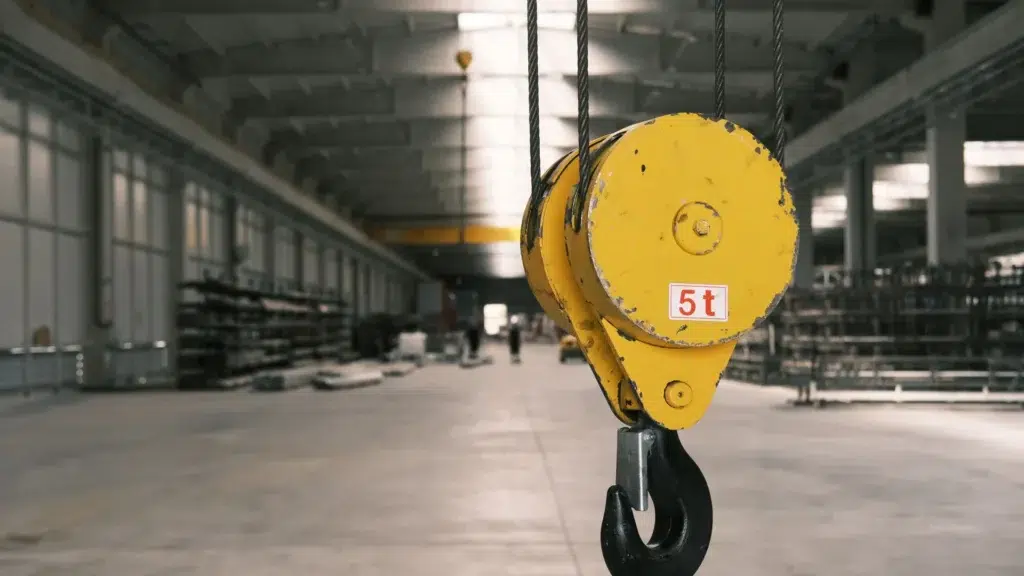
A plant manager doesn’t need to be a rigger to be responsible for a safe lift. But when something goes wrong during a heavy equipment move — a dropped load, a failed sling, an unplanned swing — it’s rarely a freak accident. It’s almost always one of a small, well-known set of preventable mistakes. Here’s what to actually understand before you authorize a lift, and the questions that tell you whether the crew doing it has it covered.
What “Rigging” Actually Covers
Rigging is the set of equipment and practices used to safely lift, move, and position a load — slings, shackles, chains, hooks, and the crane or hoist attached to them, along with the planning behind how they’re used together. In an industrial or agricultural setting, that means moving gearboxes, motors, conveyor sections, tanks, structural components, and heavy equipment during installations, relocations, and major repairs. It’s a distinct skill from operating the crane or hoist itself — rigging is about correctly identifying the load, selecting the right hardware for it, and controlling how it moves through the air.
The Mistakes Behind Most Rigging Incidents
Not knowing the real weight of the load. This is the single most common root cause. A load rated by estimate, an old spec sheet, or a guess based on “it felt about the same as the last one” is a guess dressed up as a fact. Actual weight should come from a nameplate, engineering drawing, or manufacturer data — not an eyeball estimate — because every other decision in the lift depends on that number being right.
Ignoring sling angle math. This is the mistake most likely to catch an otherwise careful crew off guard, because it’s counterintuitive. As the angle between a sling and the horizontal decreases, the tension on each leg of the sling increases sharply — not gradually. A sling rigged at a steep, near-vertical angle carries close to its rated share of the load. The same sling rigged at a shallower angle can be carrying far more tension than it looks like, using the exact same hardware and the exact same load:
| Angle From Horizontal | Tension Multiplier Per Leg |
|---|---|
| 90° (vertical) | 1.0× |
| 60° | 1.15× |
| 45° | 1.41× |
| 30° | 2.0× |
At 30 degrees, a sling is carrying double the tension it would at vertical — with no visible difference to someone who isn’t specifically checking the angle. This is why sling angle isn’t a minor detail; it’s often the difference between a lift with a comfortable safety margin and one that’s quietly overloading its rigging.
Using worn or incorrectly rated hardware. Every sling, shackle, and hook has a rated capacity, and that rating assumes the hardware is in the condition it left the factory in. Nicks, corrosion, deformation, or missing safety latches all reduce actual capacity below the number stamped on the hardware — and a rigger who hasn’t inspected the gear that day has no way of knowing whether that’s still true.
No clear lift plan or communication protocol. On anything beyond a routine, low-risk lift, there should be an understanding — even if it’s not a formal written document — of who’s directing the lift, who has authority to stop it, what the exclusion zone looks like, and what signals will be used. Most incidents involving people in the wrong place at the wrong time trace back to this step being skipped, not to a hardware failure.
Questions a Plant Manager Should Ask Before a Lift
You don’t need to run the rigging yourself to make sure it’s being done properly. Before a significant lift, it’s reasonable to ask:
- How was the load weight determined, and is there documentation to back it up?
- What’s the rated capacity of the rigging being used, and does it include margin above the actual load?
- Has the rigging hardware been inspected today, specifically for this lift?
- Is there a designated signal person, and is the exclusion zone clearly marked?
- For anything unusual, oversized, or off-center — is there a written lift plan?

A crew that answers these easily, without having to check or guess, is a crew that’s treating the lift with the seriousness it deserves.
The Saskatchewan Regulatory Context
Rigging in Saskatchewan workplaces falls under Part 14 – Rigging of The Occupational Health and Safety Regulations, 2020, with the cranes, hoists, and lifting devices themselves covered separately under Part 13. Together, these regulations put clear obligations on employers: rigging must be designed, maintained, and used within its rated capacity; that capacity must be marked on the equipment or otherwise available to workers at the site; and lifts must be carried out by competent workers who understand the load, the hardware, and the hazards involved. None of this is unusual or burdensome for a properly run crew — it’s simply the baseline a plant manager is entitled to expect on their site.
Why This Is Worth Getting Right
A rigging incident isn’t just a safety event — it’s often a total loss of the equipment being moved, unplanned downtime while the mess is sorted out, and in the worst cases, a serious injury. All of it is preventable with the same handful of basics: know the real weight, respect the sling angle, inspect the hardware, and plan the communication before the load leaves the ground.
Custom Millwright Services is a COR-certified contractor and a member of both Avetta and ISNetworld, the safety prequalification networks many Saskatchewan operations already require of their contractors. If you’ve got an equipment move coming up — from a single gearbox swap to a full line relocation — get in touch and we’ll walk you through what the lift plan looks like before anything goes in the air.