In the industrial landscape of the Canadian Prairies—from the potash mines of Unity to the grain terminals of Winnipeg—the definition of “efficiency” is changing. For decades, the traditional approach to a plant expansion or equipment overhaul was a segmented one: hire an electrical contractor for the wiring, a welder for the chutes, and a millwright to bolt the machines down.
However, as we move through 2026, the complexity of industrial automation and the tightening of provincial safety and environmental regulations have exposed the flaw in this “siloed” approach. When multiple trades operate without a singular mechanical “North Star,” the result is often a communication breakdown, budget overruns, and—the most expensive word in the Prairies—downtime.
At Custom Millwright Services (CMS), we are seeing a shift. The most successful facility managers are no longer viewing the millwright as just a technician with a wrench; they are viewing them as the essential Project Manager for the entire mechanical and electrical interface.
The Problem: The "Inter-Trade Gap"
Every industrial project has a “dead zone”—the space between where one trade’s responsibility ends and another’s begins.
Consider the installation of a new automated bagging line in a seed cleaning plant. The electrical contractor ensures power reaches the control panel. The software tech ensures the PLC (Programmable Logic Controller) is coded. But who ensures that the physical vibration of the 50HP motor doesn’t slowly shake the sensitive optical sensors out of alignment over the first week of operation? Who ensures that the custom-fabricated hopper, built off-site, actually clears the existing structural steel beams while still allowing enough “swing room” for a forklift?
When you don’t have a millwright managing the project, these “minor” miscalculations aren’t discovered until the day of the commissioning. By then, you aren’t just paying for a fix; you may be paying for five trades to wait around at $150/hour while a solution is improvised.
The Millwright Advantage: Total System Literacy
A journeyman millwright is, by nature, a multi-disciplinary expert. To be a millwright in the Prairies means you must understand:
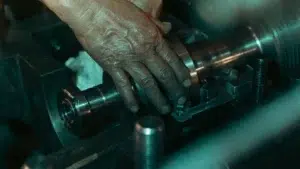
- Precision Alignment: Using lasers to ensure shafts are true to within thousands of an inch.
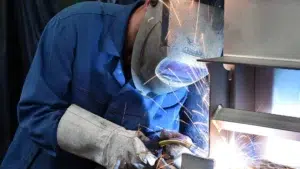
- Structural Steel: Knowing exactly where a weld needs to be reinforced to handle “live loads.”
- Fluid Power: Understanding the nuances of hydraulics and pneumatics that drive the movement.
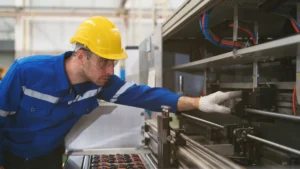
- Electrical Integration: Knowing how mechanical movement impacts (and is impacted by) electrical sensors and motors.
Because of this broad knowledge base, a millwright is often the best person on a job site who can speak “Electrician,” “Welder,” and “Engineer” simultaneously. When CMS takes the lead on a project, we aren’t just looking at the machine on the floor; we are looking at the entire ecosystem of the plant.
Case Study: The "Tight-Deadline" Turnaround
In the Ag and Mining sectors, there is no such thing as a “convenient” time for an upgrade. You are either racing against the first frost or the next rail car shipment.
Recently, a facility attempted a conveyor system swap-out using separate contractors. The electrical team finished early but left the conduit in a location that blocked the primary access point for the millwrights to move the heavy gearboxes. The result? Three days of rework.
If a millwright had been the project lead, the “path of travel” for the heavy equipment would have been the first item on the blueprint. We look at the sequence of operations. We know that the mechanical footprint dictates the electrical path, not the other way around.
Bridging the Electrical and Mechanical Interface
The most common point of failure in 2026 industrial projects is the “Handshake.” This is the moment where the mechanical movement of a machine must sync perfectly with an electrical signal.
Modern pulse plants and mining facilities rely on sub-second timing. If a millwright isn’t overseeing the installation of the sensors, they might be mounted to a bracket that experiences “harmonic vibration.” To an electrician, the sensor is wired correctly. To a software tech, the code is solid. But to the millwright, the mechanical instability makes the whole system fail.

By having Custom Millwright Services manage the project from the design phase, we ensure that the mechanical foundation is “electronically stable.” We build the brackets, we reinforce the mounts, and we ensure the environment is ready for the high-tech components that modern industry demands.
Practical Benefits for the Prairie Facility Manager
If you are contemplating a project in 2026, here is why putting a millwright in the “PM” seat saves money:
- Reduced Lead-Time Logic: We know what can be fabricated on-site versus what needs to be ordered. If a part is six weeks out, a millwright can often design a custom solution that keeps the project moving today.
- Safety as a Foundation: We don’t “bolt-on” safety guards as an afterthought. We integrate them into the mechanical design, so they don’t impede production.
- The “One Phone Call” Rule: When something goes wrong (and in heavy industry, something always does), you don’t want to spend your morning figuring out which contractor is at fault. With CMS as your lead, we take the responsibility for the final “Green Light” on the machine.
The CMS Difference: Built for the Prairies
The Canadian Prairies present a unique set of challenges. We deal with extreme temperature swings that cause metal to expand and contract in ways that “city-based” engineers often overlook. We deal with abrasive dust in grain and potash that eats through standard bearings in months.
Custom Millwright Services was built in this environment. We don’t just “install” equipment; we harden it. When we manage a project, we are applying decades of experience on frozen job sites and in high-pressure harvest windows to your facility.
Don't Just Build, Optimize.
Hiring a millwright for a project after the machines have already arrived is a reactive strategy. Hiring a millwright to manage the project from inception is a proactive one.
As the industries of the West continue to automate and evolve, the gap between “it works” and “it works perfectly” is getting smaller. Don’t let your next upgrade fall into the “Inter-Trade Gap.” Let the experts who understand the mechanical soul of your plant lead the way.