Most equipment failures don’t happen suddenly. A bearing doesn’t go from fine to seized overnight, and a gearbox doesn’t strip its teeth without warning. Almost every failure announces itself first — through sound, feel, heat, smell, or wear — often weeks before it becomes a breakdown. The question is whether anyone catches the announcement.
Large operations with vibration-monitoring software and predictive-maintenance dashboards catch some of it electronically. But across Saskatchewan’s agricultural, industrial, and manufacturing sector, a lot of equipment simply isn’t wired up that way — legacy machinery, older grain-handling systems, and general-purpose shop and yard equipment rarely have sensors attached to them at all. For that equipment, the earliest warning system that actually exists is a trained set of senses. Here’s what an experienced millwright is listening, feeling, and looking for, and why it catches problems that instrumentation would miss anyway on equipment that was never built to report on itself.
Sound: The First Thing to Change
Sound is usually the earliest and most reliable indicator something is wrong, because healthy rotating equipment has a consistent, almost boring acoustic signature. Any deviation from that baseline is worth investigating.
A high-pitched whine from a bearing housing often points to inadequate lubrication or early-stage race damage. A rhythmic knock that tracks with shaft speed usually means a bearing has developed a flat spot or spalling on the rolling elements. Grinding or growling from a gearbox suggests tooth wear or contamination in the oil. Cavitation in a pump sounds distinct from normal flow noise — it’s often described as “gravel in a blender,” and it means the pump is starving for suction and damaging its impeller with every rotation. Belt squeal points to slippage or misalignment; a rhythmic slap usually means a belt has stretched or a pulley has gone eccentric.
None of this requires special equipment. It requires knowing what normal sounds like for a specific machine, and paying attention often enough to notice when it isn’t.
Feel: What a Hand on the Housing Tells You
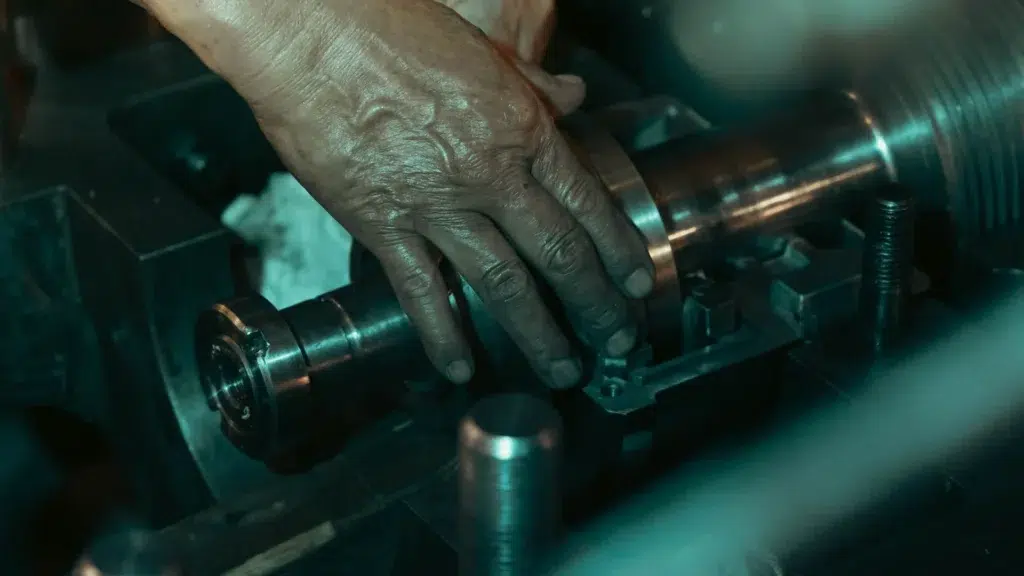
Vibration that’s severe enough to be a real problem is often felt before it’s ever measured. A hand placed on a bearing housing or motor frame can pick up on a few distinct patterns:
- A steady, low buzz usually points to imbalance — something rotating slightly off-center.
- A pulse that beats in and out of sync with running speed often indicates misalignment between coupled shafts.
- A looseness or “clunk” feel, rather than a smooth vibration, suggests worn mounting hardware, a loose foundation bolt, or excessive bearing clearance.
- Harmonic resonance — a vibration that seems to build and fade at certain speeds — can point to a structural or foundation issue rather than the machine itself.
An experienced tech isn’t guessing at these distinctions. They’re the same fault signatures a vibration analyzer would report on a graph — just interpreted through a trained hand instead of a spectrum chart. On equipment that doesn’t have a sensor mounted to it, this is often the only version of that diagnosis that exists.
Heat: What the Machine Radiates Before It Fails
Abnormal heat is one of the most dangerous signs to ignore, because by the time it’s noticeable it usually means friction has already increased significantly — a failing bearing, insufficient lubrication, or an overloaded motor. It’s rarely appropriate to make direct contact with a running housing, but heat still gives itself away: discoloration or scorching on paint near a bearing cap, grease that’s turned dark or run out of a seal, a faint burnt-oil smell near a housing, or a motor that’s noticeably warmer to the back of a hand held a few inches away than it was on the last check. A basic infrared thermometer — inexpensive and common in most shops — turns this from an impression into a number, but even without one, a tech who checks the same points regularly will notice when something’s running hotter than it used to.
Smell: An Underrated Diagnostic Tool
Smell catches problems that sound and feel sometimes miss, particularly on electrical equipment. A sharp, acrid smell near a motor is often the first sign of overheating winding insulation — a fault that can escalate quickly if ignored. A burnt-oil smell near a gearbox or bearing housing usually means metal-on-metal contact has already begun. A faint ozone smell can indicate electrical arcing inside a panel or motor. None of these smells are subtle once you know to notice them, and none of them require any equipment at all — just a nose that’s paying attention during a routine walk-through.

Visual Wear Patterns: What the Machine Leaves Behind
The clearest evidence is often sitting in plain sight. A frayed or glazed belt tells a story about tension, alignment, or pulley wear. Uneven wear across a belt’s width usually points to a misaligned pulley. Metallic sheen or fine metal particles on a magnetic drain plug — a two-minute check during a routine oil change — is often the earliest hard evidence of internal bearing or gear wear, long before it shows up as noise or heat. Oil residue patterns around a seal tell you whether a leak is new or has been slowly building for months. None of this requires lab analysis. It requires someone who knows what a healthy machine’s oil, belts, and seals are supposed to look like, and checks them on a schedule rather than only after something breaks.
Why This Matters for Your Operation
For a manufacturing line, an hour of unplanned downtime is lost production. For an agricultural operation, a breakdown during harvest can cost far more than the repair itself — it costs the window of time the crop needed to come off the field. In both cases, the value of catching a problem early isn’t really about the repair cost. It’s about catching it on your schedule instead of the machine’s.
This is also, honestly, the case for why experience matters as much as equipment. A vibration sensor only reports on the one point it’s mounted to, and only on machines someone decided were worth instrumenting. A trained millwright walking your floor or yard is evaluating everything they pass — by ear, by hand, by nose, and by eye — on the equipment that will never have a sensor bolted to it at all.
If your operation has equipment that hasn’t had a proper walk-through in a while — or if something’s started sounding, feeling, or smelling slightly different lately — that’s worth a call before it becomes a shutdown. And for equipment that does generate electrical data, our team also reads that story: see our piece on using VFD data as a diagnostic tool for what that side of the picture looks like. Between the two, very little gets past us before it’s ready to.
If your operation has equipment that hasn’t had a proper walk-through in a while — or if something’s started sounding, feeling, or smelling slightly different lately — that’s worth a call before it becomes a shutdown. And for equipment that does generate electrical data, our team also reads that story: see our piece on using VFD data as a diagnostic tool for what that side of the picture looks like. Between the two, very little gets past us before it’s ready to.