In the high-output environments of grain handling, mining, and aggregate processing, “wear” is an inescapable tax on profitability. Every metric ton of material that moves through a chute, hopper, or conveyor takes a microscopic toll on the equipment. Over time, these microscopic losses lead to macroscopic failures: thinned walls, structural compromises, and the dreaded emergency shutdown.
For a business owner or facility manager, the goal is not to eliminate wear—which is physically impossible—but to manage it through the science of sacrifice. By strategically selecting and installing wear liners, you are choosing which material will “sacrifice” itself to protect the permanent structure of your facility.
Defining the Enemy: Impact vs. Sliding Abrasion
Before selecting a material, we must understand how it is being attacked. In industrial mechanical systems, wear generally falls into two categories, and a liner that excels at one will often fail at the other.
- Sliding Abrasion (Galling and Scratching)
This occurs when material moves across a surface, like grain sliding down a chute or sand moving along a conveyor bed. The technical focus here is on surface hardness. The liner must be harder than the material moving across it to prevent the material from “plowing” into the metal.
- Impact Abrasion (Crushing and Pitting)
This occurs at transfer points where heavy material drops from a height onto a surface. Here, a liner that is too “hard” can actually be a liability. Extremely hard materials tend to be brittle; the energy of the impact can cause the liner to crack or shatter rather than absorb the blow.
The Metric of Hardness: Understanding the Brinell Scale
When reviewing quotes for fabrication or liners, you will frequently see the prefix AR, followed by a number (e.g., AR400, AR500). “AR” stands for Abrasion Resistant, and the number refers to the Brinell Hardness Number (BHN).
The science behind this is grounded in the Archard Wear Equation, which is a fundamental principle in tribology:
Where:
From a management perspective, the most important variable is $H$ . Because $H$ is in the denominator, as the hardness of your liner increases, the volume of material lost ($V$) decreases proportionally.
A Manager’s Guide to Common Liner Materials
Selecting the right material requires a balance between the “Purchase Price” and the “Replacement Frequency.” Here is a breakdown of the materials most commonly utilized by professional millwrights:
- AR400 / AR450 (The Workhorse)
AR400 is the industry standard for general fabrication. It offers an excellent balance of weldability and toughness.
- Best For: Chutes, hoppers, and truck beds where there is a mix of sliding and moderate impact.
- The Advantage: It can be formed and welded with standard shop equipment, keeping labor costs lower.
- AR500 (The Specialist)
AR500 is significantly harder than AR400, offering roughly 50% more wear life in sliding abrasion scenarios.
- Best For: High-velocity grain streams or heavy mining aggregates.
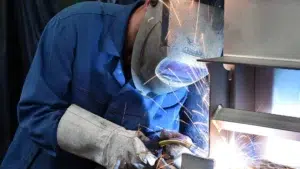
- The Technical Catch: As hardness increases, weldability decreases. AR500 requires specific pre-heating and cooling procedures during installation to prevent “Hydrogen Cracking” in the heat-affected zone (HAZ).
- Chromium Carbide Overlay (CCO)
This is a “bimetallic” plate—a mild steel base topped with a layer of extremely hard chromium-rich white iron.
- Best For: Extreme sliding abrasion where impact is minimal.
- The “Meaty” Detail: CCO plates often exhibit “check cracking,” which are tiny cracks in the hard surface. To the untrained eye, this looks like a failure, but it is actually a designed feature that relieves internal stress in the material.
- UHMW-PE (The Non-Metallic Alternative)
Ultra-High Molecular Weight Polyethylene is a technical plastic used where “slickness” is as important as wear.
- Best For: Wet materials or “sticky” grain that might cause bridging in a metal chute.
- The Advantage: It is lightweight and resistant to corrosion, though it cannot handle high temperatures or heavy, sharp-edged impact.
The Decision Matrix: Balancing Hardness and Toughness
| Material | Brinell | Impact Resistance | Weldability | Relative Cost |
|---|---|---|---|---|
| Mild Steel | 120 | High | Excellent | Low |
| AR400 | 400 | Medium-High | Good | Moderate |
| Chromium Carbide | 600+ | Low | Special Only | Very High |
| UHMW Plastic | N/A | High | N/A (Mechanical) | Moderate |
The Fabrication Reality: Why "Thicker" Isn't Always Better
A common misconception in facility management is that doubling the thickness of a liner will double its life. While it may provide more “sacrificial” material, it also adds significant weight to the structure.
A 1/2-inch plate of AR500 will often outlast a 1-inch plate of mild steel while weighing half as much. For a millwright, this weight reduction is critical because it reduces the load on the supports, motors, and bearings of the surrounding system.
The Problem of "Cold Work"
When we fabricate these liners, we have to be careful with how they are handled. Many abrasion-resistant steels “work-harden.” If they are cut or drilled with the wrong tools, the metal becomes brittle at the edges. Professional millwrights use specialized plasma or water-jet cutting to ensure the integrity of the liner is maintained from the shop to the field.
Practical Application: How to Audit Your Own Facility
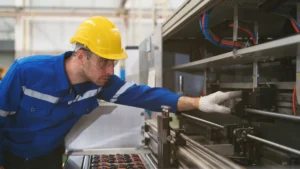
As you walk your floor, look for these three “Technical Red Flags” that suggest your current liner strategy is failing:
- “Washboarding” in Chutes: If you see a ripple pattern in your liners, it’s a sign of harmonic vibration or that the material is too soft for the impact angle.
- Premature Weld Failure: If the liner is still thick but the welds are popping, you likely have an incompatible material match (e.g., trying to weld high-carbon AR500 to mild steel without proper transition rods).
- Material “Hang-up”: If material is sticking to the liners, the surface is too pitted. A switch to a material with a lower coefficient of friction (like UHMW or a polished AR plate) is required.
Investing in the Lifecycle
For the manager of a custom millwright project, the choice of wear liner is a hedge against future downtime. Selecting a “cheaper” mild steel liner might save 20% on the initial fabrication cost, but it could cost 300% more in labor and lost production over a three-year period.
At Custom Millwright Services, we believe that “Shop Talk” should always be grounded in these technical realities. We don’t just “patch holes”; we analyze the wear environment to ensure that the materials we install are the most efficient sacrifice for your long-term success.
When your automation is in need of repair or replacement, consider asking Custom Millwright Services to assess your situation. We will be honest and fair. Our material selection will be matched to your real needs.