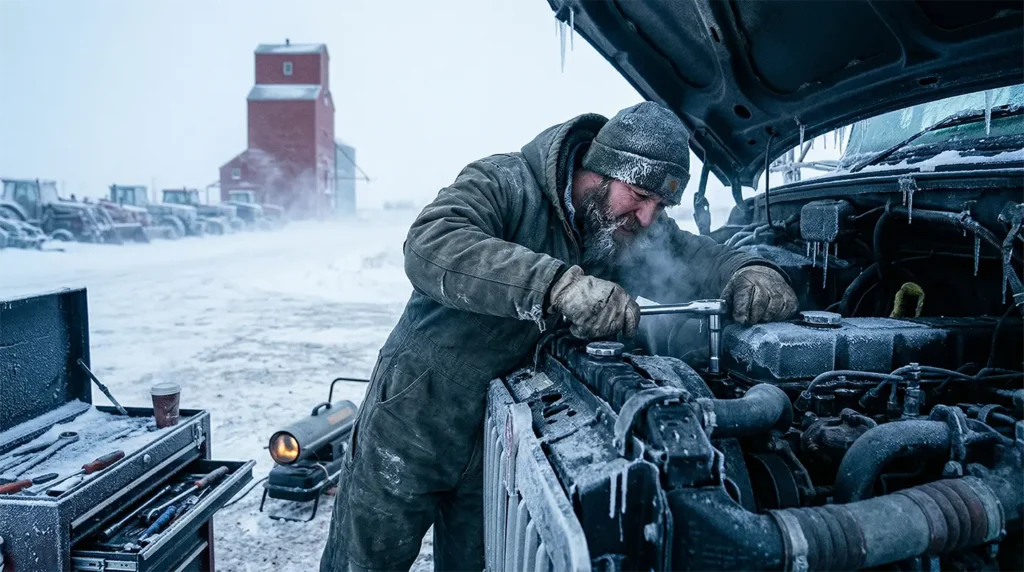
In the Canadian Prairies, is the great equalizer. It is the temperature where the Celsius and Fahrenheit scales meet, and where standard industrial maintenance protocols fall apart. For a millwright working in a grain terminal or a potash mine, this temperature isn’t just a weather report—it is a threshold where steel becomes brittle, lubricants turn into solids, and rubber seals crack like glass.
Many facility managers view winter maintenance as a “reactionary” cost: fixing things when they break in the cold. But at Custom Millwright Services (CMS), we advocate for Arctic-Grade Preventative Maintenance. Understanding the technical nuances of how extreme cold impacts mechanical systems is the only way to ensure your facility doesn’t become a frozen monument to unplanned downtime.
1. The "Glass Transition": When Rubber and Plastics Fail
One of the most common “silent” failures in a Prairie winter happens at the molecular level. Most standard industrial seals, O-rings, and drive belts have what is known as a Glass Transition Temperature.
When the mercury hits , many standard elastomers (like Nitrile or certain Neoprenes) reach their . They lose their “rubbery” elasticity and become as brittle as a pane of glass.
- The Millwright Tidbit: If a conveyor belt is stopped for a long period in extreme cold and then suddenly tensioned upon startup, the rubber doesn’t stretch—it micro-fractures.
- The CMS Fix: We recommend “pre-winterizing” critical drive systems with Silicone or Fluorocarbon (Viton) seals rated for . For drive belts, switching to EPDM (Ethylene Propylene Diene Monomer) compounds ensures they remain flexible enough to wrap around pulleys without cracking during a cold start.
2. Lubrication: From Fluid to "Taffy"
Standard mineral-based oils and greases are designed for a moderate operating window. As temperatures drop, their viscosity increases exponentially. At , standard ISO 220 gear oil can become so thick that the oil pump in a gearbox cannot move it. This leads to “starvation,” where the gears turn but have zero protective film, causing catastrophic metal-on-metal wear in the first 60 seconds of operation.
- The Technical Tidbit: Look for the Pour Point on your lubricant’s data sheet. For Prairie operations, you need a lubricant with a pour point at least lower than your expected ambient temperature.
- The CMS Fix: We transition our clients to Full Synthetic PAO (Polyalphaolefin) oils. Unlike mineral oils, synthetics don’t contain wax parrafins that crystallize and “gel” in the cold. For grease points, we utilize NLGI #0 or #00 “Soft” Greases in the winter, which maintain pumpability in centralized lubrication systems when a standard #2 grease would clog the lines.
3. Structural Steel and the "Cold Brittle" Factor
Most people think of steel as indestructible, but carbon steel undergoes a Ductile-to-Brittle Transition in extreme cold. If a structural support or a hopper is subjected to a sudden “shock load” (like a heavy slug of grain or ore hitting a bin) at , the steel can crack rather than bend.
- The Technical Tidbit: Standard A36 structural steel is highly susceptible to “Charpy V-Notch” failures in sub-zero temps. If your facility has aging catwalks or gantries, the vibration from a misaligned motor acts like a hammer on brittle glass.

- The CMS Fix: This is where Laser Alignment becomes a safety tool. By removing the “harmonic vibration” caused by a misaligned shaft, we reduce the repetitive stress on the brittle steel structure. During winter inspections, we also look for “stress risers”—notches, nicks, or poor welds where a crack is likely to start.
4. Pneumatics: The "Ice Blockage" Nightmare
Compressed air systems are the lifeblood of automated Prairie plants, but they are the first to fail in a cold snap. As warm compressed air travels through a cold pipe, the moisture in the air condenses and freezes instantly.
- The Technical Tidbit: It’s not just about the “water in the line.” It’s about Desiccant Saturation. In the summer, your air dryer works hard to pull moisture out. If those desiccant beads aren’t replaced in the fall, they hit “dew point” in the winter, sending “slush” directly into your solenoid valves.
- The CMS Fix: We perform “Air Audits” in October. We ensure the Auto-Drains on your receiver tanks are heated and functional, and we verify that the Pressure Dew Point (PDP) of your dryer is at least . If a valve freezes, don’t hit it with a torch—that destroys the internal seals. We use targeted heat-trace or specialized “Air-Line Antifreeze” to safely restore flow.
5. The "Cold Start" Protocol: Protecting the Bearings
The most damage a machine will ever sustain in the Prairies happens in the first 10 minutes of a Monday morning startup in January.
- The Technical Tidbit: Bearings require a “clearance” to operate. In extreme cold, the outer race (touching the cold housing) contracts faster than the inner race (staying slightly warmer), which can “pinch” the rolling elements and cause “skidding” instead of rolling.
- The CMS Fix: We help facilities implement a Gradual Warm-up Procedure.
- Jog the motor: 5 seconds on, 30 seconds off (repeat 3 times) to move the “taffy-like” grease.
- Idle run: Run at 25% load for 15 minutes to allow internal friction to naturally warm the bearing housings.
- Vibration Check: Listen for the high-pitched “squeal” of a cold-starved bearing. If you hear it, stop. The grease hasn’t reached the race yet.
Why Preventative Maintenance is a "Spring" Activity
The irony of maintenance is that it should be done in May. You don’t want to be swapping out a frozen gearbox in a blizzard; you want to have the Arctic-Grade Synthetic already in that gearbox before the first frost.
At Custom Millwright Services, our goal is to make “Winter Emergencies” a thing of the past. By auditing your seals, lubricants, and structural integrity during the temperate months, we ensure that when the wind starts howling across the Prairies, your facility stays loud, productive, and—most importantly—moving.
Typical Lubricants Through The Year
| Component | Standard/Summer Grade | Arctic/Winter Grade (−40∘C Capable) | Why it Matters |
|---|---|---|---|
| Gearboxes (Enclosed) | ISO 220 or 320 Mineral | ISO 150 or 220 Full Synthetic (PAO) | Mineral oil waxes crystallize in the cold; PAO stays fluid to prevent "dry starts." |
| Electric Motor Bearings | NLGI #2 Polyurea | NLGI #1 or #0 Synthetic Lithium Complex | Reduces "startup torque" and prevents the motor from tripping breakers in the cold. |
| Hydraulic Systems | ISO 46 Anti-Wear (AW) | ISO 15 or 22 High VI (Multi-grade) | High Viscosity Index (VI) oil maintains its thickness even as the system warms up. |
| Conveyor Bearings | NLGI #2 General Purpose | NLGI #0 Synthetic (with Moly) | Lower "soap" content allows grease to flow through long automated lube lines. |
| Chain Drives | Standard Tacky Chain Lube | Synthetic "Dry" Film or Low-Temp Oil | Prevents "clumping" of dust and ice which can cause chain-skip or derailment. |
| Pneumatic Tools | Standard Air Tool Oil | Winter-Grade / Kilfrost Lubricant | Absorbs trace moisture to prevent internal valve icing. |
Final Tips
- The “Color Code” Strategy: You may want to color-code your grease guns or oil canisters (e.g., Blue for Winter, Red for Summer). This prevents a well-meaning tech from accidentally pumping thick summer grease into a critical bearing in December.
- The “Pour Point” Warning: Remember that the “Pour Point” of the oil should be at least below the coldest expected morning. If it’s outside, you want a lubricant that can still flow at that insanely cold morning as well as it did when you poured it in!
- The “Flush” Procedure: When CMS does these swap-outs, we NEVER just “top it off.” Mixing mineral and synthetic oils can lead to “sludging.” A professional flush ensures the new Arctic-grade fluid isn’t contaminated by leftover summer “taffy.”